From animals to humans and across age groups we learn to solve patterns. Whether it is an octopus escaping from a jar, a child learning to walk, solving a rubrics cube or solving a differential equation. We learn to solve problem and in some cases like when a child is learning to walk a parent, or an adult helps by facilitating and guiding the learning process.
Problem based learning is an old theory which was originally developed by Barrows and Tamblyn (1980) for medical education. It is based on the constructivist theory of learning (Savery and Duff, 1995, and Jonassen 2003). Barrows and Tamblyn, 1980, stated that this approach was custom made for medicine and allows for both knowledge acquisition and development of essential skills. It is a student focused approach and allows the students to take control of their own learning as well as their motivation to learn.
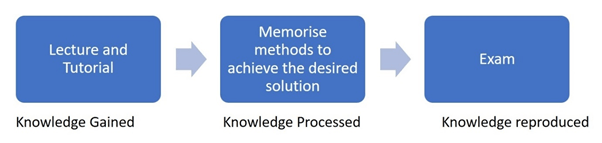
In our traditional model of learning is highly focused on exams. The lectures and tutorials form the main basis of the teaching, this is where the majority of the knowledge is learned, we then teach students how to solve the problem with a formula or method, students learn how to reach the answer using these methods and then students reproduce the results in the exams. We judge the exams to assess how well they have learned.
Problem-based learning on the other hand is student focused and comprises an open-ended problem with relevant real-life implication and intended solution. However, there is no path to reach this solution. The path to the solution allows students to be creative and explore the solutions.

Problem-based learning can even go further where the students have to also pose the problem to be solved (Lewis et al, 1998). Problem-based learning is also a iterative approach to teaching where at every stage between the posing of the problem to finding the solution there is interaction between the instructor who scaffolds the students learning and leads the students in the correct direction while the students engage in the learning process actively (Dahms et al, 2017).
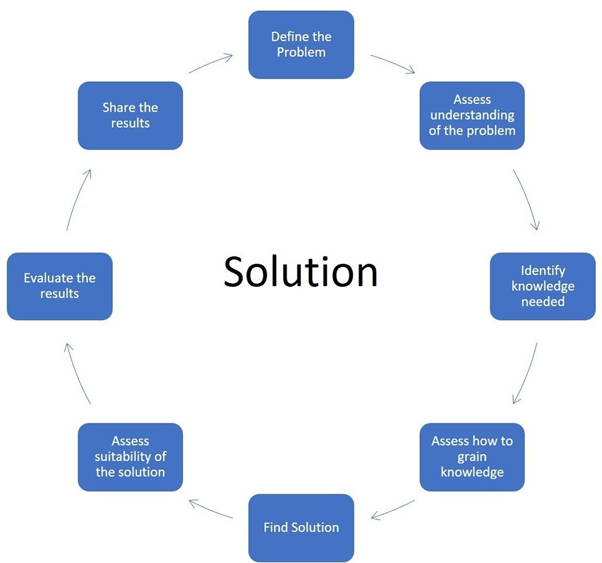
Therefore, we can say that Problem-based learning has four main parts:
- Personalized: It is student focused and led.
- Authentic: Uses relevant real-world problems that are meaningful to the students
- Guided: Instructor uses their knowledge to lead students with resources and discussions
- Iterative: It is an iterative process with interaction and feedback at each step.
References
Barrows, H. S., & Tamblyn, R. M. (1980). Problem-based learning: An approach to medical education (Vol. 1). Springer Publishing Company.
Dahms, M. L., Spliid, C. M., & Nielsen, J. F. D. (2017). Teacher in a problem-based learning environment–Jack of all trades? European Journal of Engineering Education, 42(6), 1196-1219.
Jonassen, D. H., Howland, J., Moore, J., & Marra, R. M. (2003). Learning to solve problems with technology: A constructivist perspective.
Lewis, T., Petrina, s. and Hill, A. M. (1998) Problem Posing-Adding a Creative Increment to Technological Problem solving. Journal of Industrial Teacher Education, 36 (1)
Savery, J. R., & Duffy, T. M. (1995). Problem based learning: An instructional model and its constructivist framework. Educational technology, 35(5), 31-38.
 Community of Inquiry