In the previous post, we looked at how the pandemic can be a catalyst for change that forced us to engage with how we can prepare for the future and pandemic-proof our subjects. We concluded that a necessary first step would be to design the online learning curriculum around a community of inquiry (COI) (Garrison, 2007). The idea of the community of inquiry is increasing in popularity of a community-centred framework where students can engage with peers and the lecturers (Shea & Bidjerano, 20). The COI is often demonstrated with a diagram showing overlapping domains of social presence, teaching presence and cognitive presence (Garrison, 2007) .
Social presence focuses on the encouraging group cohesion between learners. Cognitive presence focuses on the development of motivation for inquiry, toward seeking out the knowledge. Teaching presence points to the need for design and understanding the focus of instruction types (facilitation and direct instruction) (Garrison, 2007). This framework proposes that social presence within the group, teaching presence and cognitive presence together will improve student engagement and learning (Garrison, 2007).
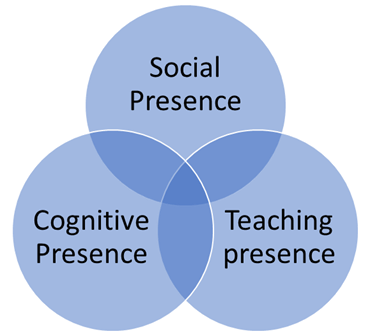
Community of Inquiry Framework showing the three domains. (Adapted from (Garrison, 2007))
At a first read and looking at the diagram of the framework it could easily be assumed that the three domains of the framework have equal contributions toward the educational experience. However, this may oversimplify the issues encountered and to hypothesise that there could potentially be greater interaction between the three domains. This would further lead to considering if the weighting of the three domains needs to be reassessed. I further review of the literature and research highlights that there is sufficient evidence that there is, in fact, a co-dependent relationship between the individual components of the COI (Shea, et al., 2014).
The finding of co-dependency is not surprising considering all three domains all focus on the student. Therefore, a fourth domain ‘Learner Presence’ was proposed (Shea, et al., 2014). In this study, the authors found that Social presence was by far the biggest factor, followed by the cognitive presence and then the learner presence and the teaching presence was the least. Further, there was a significant correlation between the learner presence and social presence and social presence and cognitive presence (Shea, et al., 2014). Several studies have identified social presence as a critical factor in student engagement (Nejkovic & Tosic, 2018; Kerrie, Bremel, Alam, & Madhavan, 2016; Shea, et al., 2014; Phan, McNeil, & Bernard , 2016). These results along with a review of the other literature would necessitate a rethinking of the COI and potentially realigning the domains.
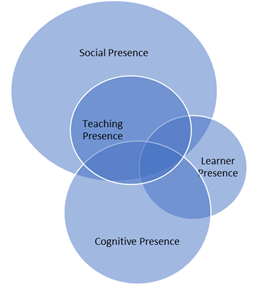
A modified Community of Inquiry Framework showing the three domains.
This is reflective posts toward the completion of EDUC90970 Facilitating online learning.
References
Garrison, D. R. (2007). Online community of inquiry review: Social, cognitive, and teaching presence issues. Journal of Asynchronous Learning Networks,, 11(1), 61-72.
Kerrie, D. A., Bremel, P., Alam, M., & Madhavan, K. (2016). Big Data Characterization of Learner Behaviour in a Highly Technical MOOC Engineering Course. Journal of Learning Analytics, 3(3), 170-192.
Nejkovic, V., & Tosic, M. (2018). Exploring factors for effective use of online information in SPOC within the engineering education. Computer Applications in Engineering Education, 26(5), 1457-1469.
Phan, T., McNeil, S. G., & Bernard , R. R. (2016). Students’ patterns of engagement and course performance in a Massive Open Online Course. Computers & Education, 95, 36-44.
Shea, P., & Bidjerano, T. (20). Community of inquiry as a theoretical framework to foster “epistemic engagement” and “cognitive presence” in online education. Computers & Education, 52(3), 543-553. doi: https://doi.org/10.1016/j.compedu.2008.10.007
Shea, P., Hayes, S., Uzuner-Smith, S., Gozza-Cohen, M., Vickers, J., & Bidjeranof, T. (2014). Reconceptualizing the community of inquiry framework: An exploratory analysis. The Internet and Higher Education, 23, 9-17.
 Community of Inquiry