The year 2020, has been a catalyst for change across the globe. In January 2020, the United Nations Foundation published a blog post highlighting 5 global issues to watch in 2020 (Brown, 2020). The global pandemic from COVID-19 was not one of them. Yet by March 2020, the real effects of COVID-19 was being felt across the globe and by April 2020, the world was closed to international travel.
The drastic changes in our global society from COVID-19 has affects all areas of our lives including University teaching (Crawford, et al., 2020). The University sector in Australia committed to moving our subjects online. Looking back at what we have achieved in a short period of time we can give ourselves a pat on the back that we have survived. The quality of our education and its outcomes for students may not fully be assessed for a while yet. But this has also showed us how uthat we can do much better to prepare our University courses and subjects to be more ready for an online audience.
Surprisingly, there has not been as much resistance reported in blogs from students to engaging with online learning as many has hypothesised in the past (Cooper, 2005). Students complaints of lecturers digital competencies have been overshadowed by a sense of gratitude for the availability of technology (Zentari, et al., 2020; UNSW, 2020). Instead student problem areas have been around, the loss of a sense of community (UNSW, 2020; Zentari, et al., 2020).
The pandemic can be a catalyst for change, to disrupt the way we teach and prepare our classrooms for the future. But a necessary first step must be to design the online learning curriculum around a community. Although it must be recognised that social equity is an issue for technology accessibility globally, we are at a stage where technology itself is not a barrier for online delivery and learning. However, without a sense of community there will be an increased dropout of students as seen with many Massive Open Online Courses (MOOCS) (Rizzardini & Amado-Salvatierra, 2018).
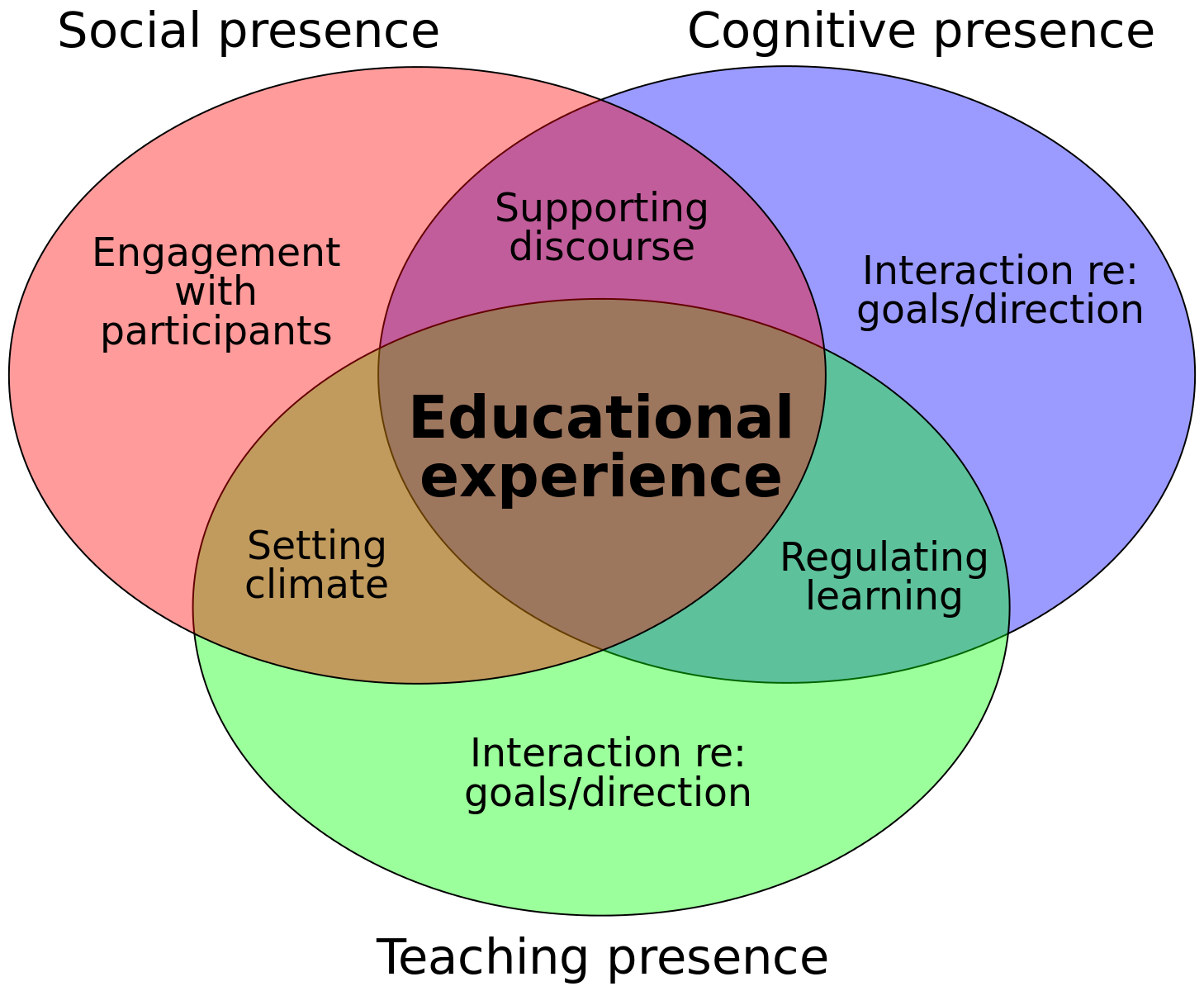
Based on Garrison et al., 2009, image by Matt Burry (Creative Commons Attribution-Share Alike 3.0 Unported)
One of the more recent ideology in learning and teaching is the need to develop community-cantered framework where students can engage with peers (Shea & Bidjerano, 20). Also known as the Community of Inquiry framework, it focuses on developing a community focusing on Social presence, Teaching presence and congnitive presence (Garrison et al., 2009). This approach has shown promise in creating a sense of belonging in students that lasts beyond the duration of the course (Rizzardini & Amado-Salvatierra, 2018; Shea & Bidjerano, 20).
This is reflective posts toward the completion of EDUC90970 Facilitating online learning.
Bibliography
Brown, K. (2020, January 08). United Nations Foundation. Retrieved from https://unfoundation.org/blog/post/5-global-issues-to-watch-in-2020/
Cooper, M. (2005). Remote laboratories in teaching and learning – issues impinging on widespread adoption in. International Journal of Online Engineering, 1(1).
Crawford, J., Butler-Henderson, K., Rudolph, J., Glowatz, M., Matt, G., Rob, B., . . . Sophia, L. (2020). COVID-19: 20 Countries’ Higher Education Intra-Period Digital Pedagogy Responses. Journal of Applied Teaching and Learning.
Garrison, D. R., Anderson, T., & Archer, W. (2000). Critical inquiry in a text-based environment: Computer conferencing in higher educationmodel. The Internet and Higher Education, 2(2-3), 87-105.
Kerrie, D. A., Bremel, P., Alam, M., & Madhavan, K. (2016). Big Data Characterization of Learner Behaviour in a Highly Technical MOOC Engineering Course. Journal of Learning Analytics, 3(3), 170-192.
Phan, T., McNeil, S. G., & Bernard , R. R. (2016). Students’ patterns of engagement and course performance in a Massive Open Online Course. Computers & Education, 95, 36-44.
Rizzardini, R. H., & Amado-Salvatierra, H. R. (2018). Exploring New Ways to Increase Engagement in Full-Path MOOC Programs. International Conference on Learning and Collaboration Technologies (pp. 16-25). Springer.
Shea, P., & Bidjerano, T. (20). Community of inquiry as a theoretical framework to foster “epistemic engagement” and “cognitive presence” in online education. Computers & Education, 52(3), 543-553. doi: https://doi.org/10.1016/j.compedu.2008.10.007
UNSW. (2020, March). Student panel breaks down assumptions about online learning. Retrieved from Inside UNSW: https://www.inside.unsw.edu.au/academic-excellence/student-panel-breaks-down-assumptions-about-online-learning
Zentari, M., Ridzwan, A., Chung, H., Gregg-Rowan, C., Zahroh, R. I., & Tapa, J. (2020, May 15). Being a student during COVID-19. Retrieved from Pursuit, University of Melbourne: https://pursuit.unimelb.edu.au/articles/being-a-student-during-covid-19
 Community of Inquiry
Hi Sam – love the introduction video! A great way to virtually get to know you a little. You might find the following articles interesting regarding utilising biometric triangulation to provide feedback on the impact of VR enhanced clinical simulation training: Cochrane, Thomas, Cook, Stuart, Aiello, Stephen, Aguayo, Claudio, Dañobeitia, Cristobel, & Boncompte, Gonzalo. (2018, 4-7 December). Designing immersive mobile learning mixed reality for paramedic education. Paper presented at the 2018 IEEE International Conference on Teaching, Assessment, and Learning for Engineering (TALE), University of Wollongong, Australia. 10.1109/TALE.2018.8615124
Aguayo, Claudio, Dañobeitia, Cristobel, Cochrane, Thomas, Aiello, Stephen, Cook, Stuart, & Cuevas, A. (2018). Embodied reports in paramedicine mixed reality learning. Research in Learning Technology, 26. doi: https://doi.org/10.25304/rlt.v26.2150
LikeLike
Sam,
Good stuff!
I agree that “…technology itself is not a barrier for online delivery and learning…” but of course it is a barrier if your internet connection doesn’t work! I’ve sat through a bunch of online presentations by students completing projects as part of their “capstone” subject and felt frustrated when the audio and video cut out unexpectedly, and I felt really sorry for the students. I wonder if we could say that we are no longer limited by our *conception* of technology and what it can deliver (how long before cerebral implants and retinal re-construction allow us to watch a screen by closing our eyes? Watch “Black Mirror”!) and that is *should* no longer be a barrier to forming communities online, but the pandemic has rather forced us to “front run the trade” so to speak.
IMHO, MOOC’s were always going to be a lemon. In the 1950’s people said the same thing about the educational opportunities that would be provided by television. Now how did that go?
🙂
Lyle.
LikeLike
Sam’s discussion on the need for a community-centred framework, in recognition of the importance of engaging with peers, parallels my discussion on the need for a community of learners. While this approach has shown promise in creating a sense of belonging in students that lasts beyond the duration of the course (Rizzardini & Amado-Salvatierra, 2018; Shea & Bidjerano, 20), it would be useful for some active research into the different mechanisms by which the community can be built. Also, as a community is never static, how the community evolves over the duration of the course is an important aspect that feeds into learning.
LikeLike